Kulintangan: Sabah's Traditional Gong Music
What is kulintangan?
Kulintangan is traditional gong music played across Sabah by the Bajau, Suluk, Murut and Kadazan-Dusun. A row of 8 to 12 small bronze gongs is struck with padded mallets in a pentatonic scale, forming part of a shared maritime Southeast Asian musical tradition.
What is kulintangan
Kulintangan, also known as kulintang, is a traditional gong music found across several of Sabah's communities. It is played by the Bajau, Suluk, Murut and Kadazan-Dusun, each with their own regional variations in style and tuning.
At its heart, kulintangan is among the most sophisticated indigenous musical traditions in Sabah. Far from a simple folk form, it involves intricate rhythmic interplay and skilled players, and today professional ensembles perform it internationally.
This page explains the instrument and how it is played, its scale, rhythm and ensemble, the occasions on which it is heard, the wider maritime tradition it belongs to, and the related Kadazan-Dusun sompoton.
The instrument and how it is played
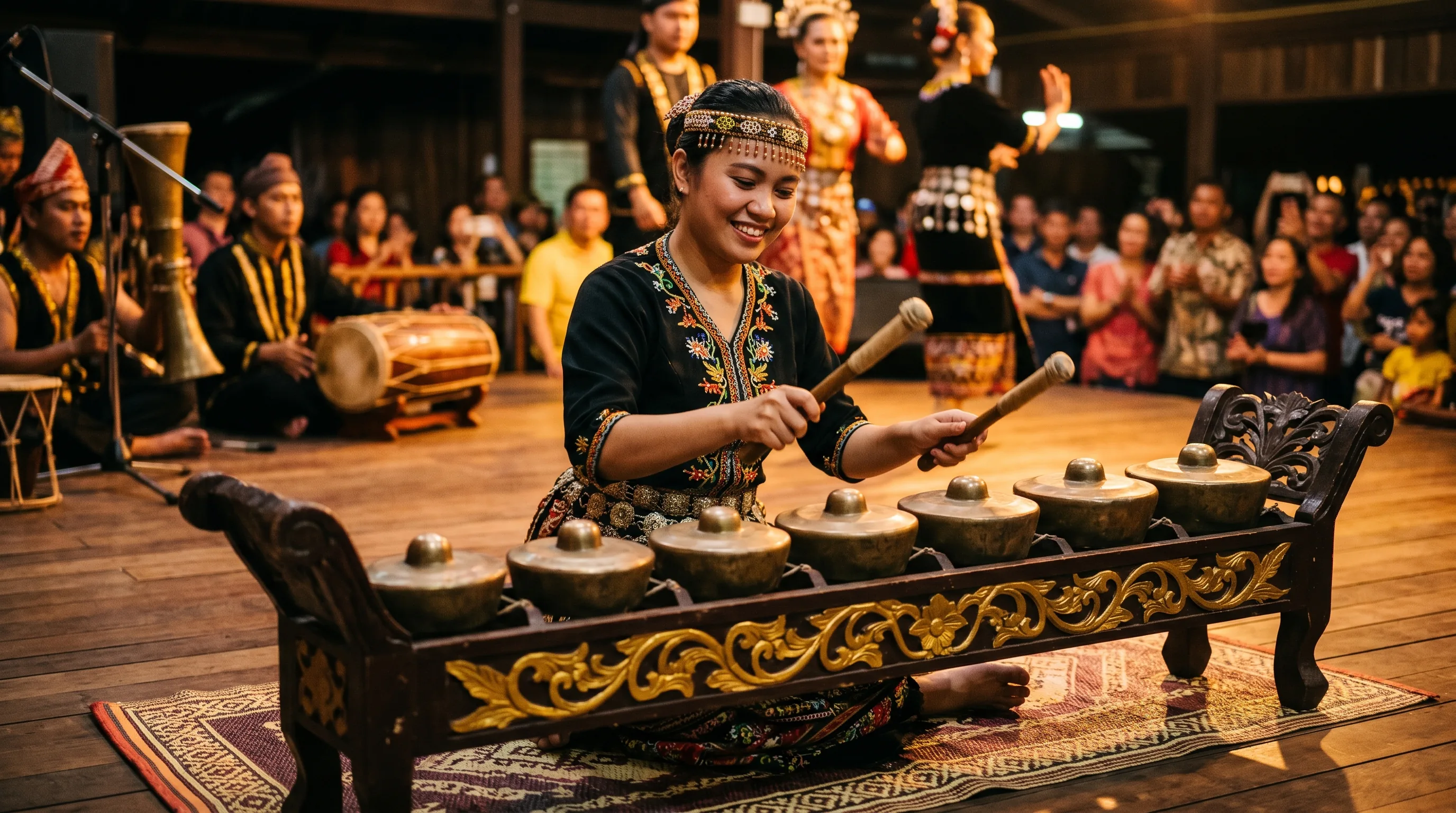
The kulintangan instrument is a row of 8 to 12 small bronze or brass gongs placed horizontally on a rack. Each gong is a small kettle-shaped instrument, and together they form a tuned set laid out in a line in front of the player.
To play, the musician strikes the gongs with padded mallets, moving across the row to sound different pitches. The padded mallets give the gongs their warm, resonant tone, and the horizontal layout lets a single player command the full set of pitches.
The kulintangan is not one gong but a set of 8 to 12 small bronze gongs arranged horizontally on a rack. The player strikes them with padded mallets to produce melody and rhythm at once.
Scale, rhythm and ensemble
Kulintangan is built on a pentatonic, five-note scale, and the tuning varies between communities — so the Bajau, Suluk, Murut and Kadazan-Dusun versions each have their own characteristic sound. Musically, the style is defined by interlocking rhythmic patterns and complex polyrhythm, where parts weave together into a dense, driving texture.
The gongs are rarely played alone. Kulintangan is often performed with the gandang (a barrel drum), the agung or gong, and other percussion. In this ensemble, the kulintangan carries the melodic and rhythmic lead while the drums and larger gongs provide the underlying pulse and accents.
When and why it is performed
Kulintangan accompanies many of the most important moments of community life. It is heard at social gatherings, ceremonies, harvest festivals and healing rituals, marking both celebration and ritual occasions.
Its role at events like harvest festivals ties the music to the rhythms of the agricultural and social calendar, while its use in healing rituals shows that kulintangan carries spiritual as well as celebratory significance. This breadth of context is part of why the tradition has remained central across so many of Sabah's communities.
A shared maritime tradition
Kulintangan is not unique to Sabah. The tradition extends across the Sulu Archipelago and coastal Sabah, into Mindanao in the Philippines and Sulawesi in Indonesia. It is part of a shared maritime Southeast Asian musical tradition that links communities across the seas of the region.
This wider spread helps explain the regional variations within Sabah itself: the music belongs to a network of related gong traditions stretching across maritime Southeast Asia, with each community adapting it to its own tuning and style while remaining part of a common heritage.
The related sompoton
Alongside kulintangan, Sabah is home to another distinctive instrument worth knowing: the sompoton. The sompoton is a Kadazan-Dusun mouth organ made of eight bamboo tubes set into a dried gourd resonator.
Each of the eight tubes contains a free vibrating reed, and the instrument produces simultaneous chords as the player blows and draws air through the gourd. Where kulintangan is a tuned set of struck gongs, the sompoton is a wind instrument capable of layered harmony — together they show the range of Sabah's indigenous musical heritage.
Cultural performances and festivals are the best places to hear both the kulintangan gong ensemble and the sompoton mouth organ in their proper setting, played by Sabahan musicians.