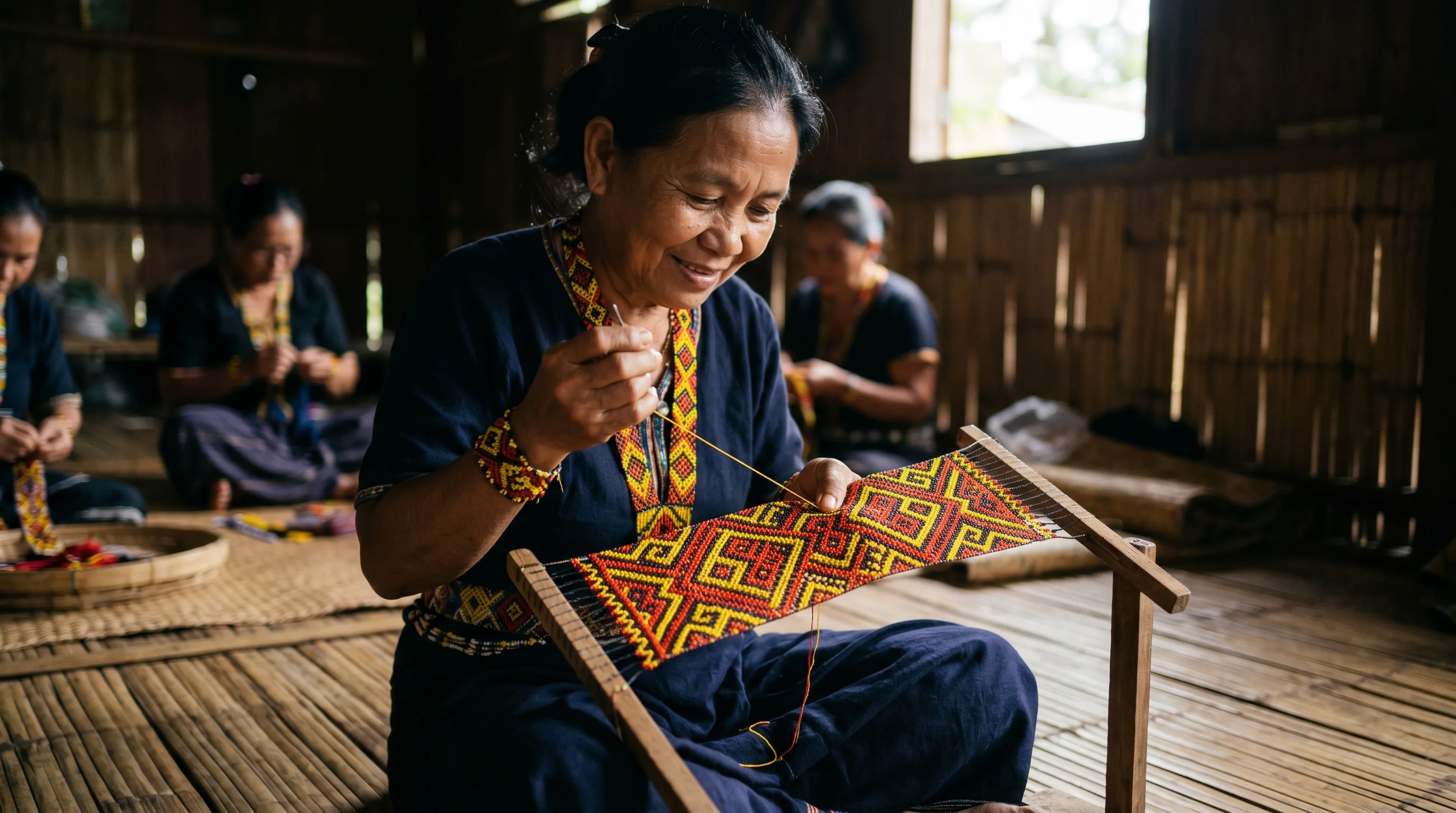
Rungus Pinakol Beadwork: Sabah's Bead-Weaving Craft
What is Rungus pinakol beadwork?
Pinakol is the beadwork tradition of the Rungus people of northern Sabah, made by off-loom bead weaving rather than embroidery. Beads are woven into geometric man, flower, spear and river-creature patterns, then assembled into necklaces, belts and headdresses.
What is Rungus pinakol beadwork
Pinakol beadwork is one of the most distinctive craft traditions of the Rungus people of northern Sabah, who live mainly in the Kudat and Kota Marudu districts. The Rungus are renowned for their intricate beadwork, which appears across their ceremonial dress and everyday adornment.
What sets Rungus beadwork apart is not only the boldness of its patterns but the method behind it. Rather than stitching beads onto cloth, Rungus artisans weave the beads themselves into patterned panels, which are then assembled into finished pieces. The result is a craft that is both highly structured and richly symbolic.
This page explains how Rungus pinakol is made, the four patterns that define it, the colours and materials involved, the items it is turned into, and where you can see and buy it today.
The off-loom weaving technique
The defining feature of Rungus beadwork is its technique: it is off-loom bead weaving, not embroidery. This is an important distinction. In embroidery, beads are sewn directly onto a fabric backing. In Rungus pinakol, the beads are instead woven together in geometric patterns on a separate loom-like frame, forming a flexible beaded panel.
Once a panel is woven, it is assembled into accessories — joined, shaped and finished into the final object. Because the patterns are built up bead by bead through weaving, the geometry is precise and the motifs hold their form, giving Rungus pieces their characteristic crisp, repeating designs.
A common misunderstanding is that Rungus beadwork is embroidered onto cloth. It is not. The beads are woven on a frame into a patterned panel first, and only then assembled into a necklace, belt or headdress.
The four primary patterns
Rungus pinakol is organised around four primary patterns, each carrying its own meaning within the tradition:
| Pattern | Motif |
|---|---|
| Man / human figure | A stylised human figure |
| Flower | Tropical flora of Sabah |
| Spear | A warrior motif |
| Fluvial creature | A river animal or water creature |
These four motifs — the human figure, the flower, the spear and the fluvial creature — recur across Rungus beadwork. Their geometric, woven form makes them instantly recognisable, and together they give the craft a visual language rooted in the people, plants, warrior heritage and rivers of northern Sabah.
Colours and materials
Colour is central to the look of Rungus beadwork. Traditionally, pieces use earth tones together with bright red, yellow and black. This palette gives older and more traditional work its grounded, striking appearance, with the bold primary accents standing out against deeper earthy shades.
More recent pieces are not limited to that scheme. Modern versions use wider palettes, drawing on a broader range of bead colours. This means visitors today may encounter both the classic earth-tone-and-primary look and newer, more varied colour combinations side by side.
In every case, the building block is the bead itself: small beads woven in their thousands to form each patterned panel that becomes part of a finished piece.
What the beadwork is made into
Once woven and assembled, Rungus beadwork becomes a range of accessories. Traditionally these include necklaces, bracelets, headdresses and ceremonial belts — pieces worn as adornment and as part of ceremonial dress.
In contemporary craft, the same technique is also applied to newer products such as handbags, adapting an old tradition to items that suit modern use and the visitor market. This blend of ceremonial pieces and everyday accessories keeps the craft alive and commercially relevant while preserving its traditional patterns.
Learning and where to find it
Rungus beadwork has traditionally been passed from mother to daughter, learned at home within the community. Today, the younger generation increasingly learns at the KDCA and at cultural centres, where the skills are taught more formally to help keep the tradition going.
For visitors, Rungus beadwork is among Sabah's most distinctive craft traditions and can be found for sale at the Gaya Street market in Kota Kinabalu and at the KDCA cultural village. Buying directly supports the artisans and the continued practice of the craft.
To see Rungus pinakol beadwork up close, visit the Gaya Street market in Kota Kinabalu or the KDCA cultural village, where pieces are sold and the tradition is shared with younger learners.