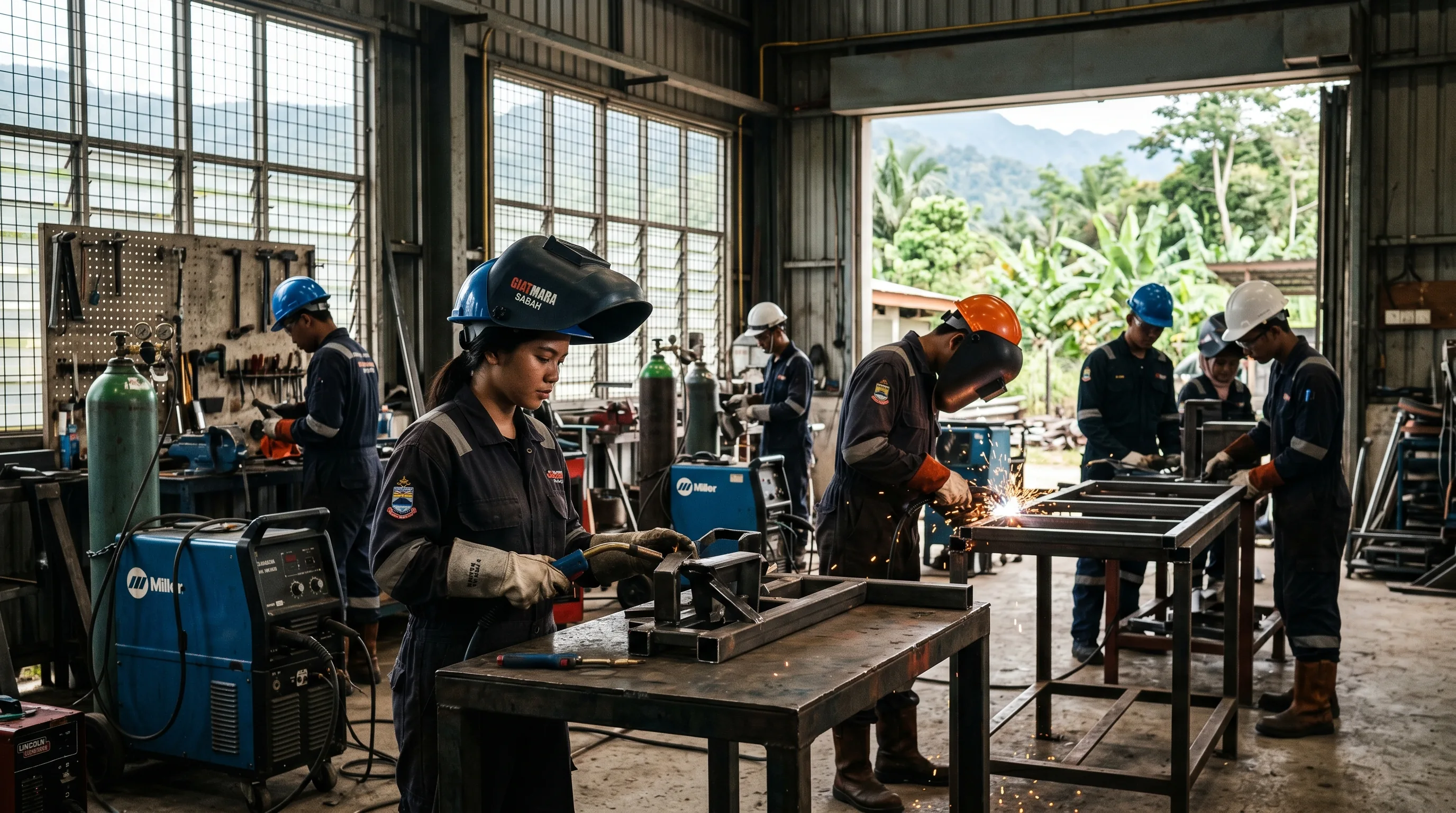
TVET in Sabah: Polytechnic, IKM & GIATMARA Guide
What TVET institutions are available in Sabah?
Sabah's main TVET providers are Politeknik Kota Kinabalu (diploma engineering), IKM Kota Kinabalu (certificates, diplomas and MARA-PETRONAS 6G welding), and GIATMARA's 28 centres offering short vocational courses statewide.
What is TVET and why does it matter for Sabah?
TVET stands for Technical and Vocational Education and Training: hands-on, skills-focused education that prepares people for specific trades and technical jobs rather than the more academic path of a university degree. In Sabah, TVET carries unusual weight. The state's economy leans heavily on sectors that run on skilled hands, including oil and gas, manufacturing, construction, automotive servicing and hospitality, and these sectors need a steady pipeline of certified technicians, welders, electricians and mechanics far more than they need generalist graduates.
Sabah also faces real educational headwinds. The state records one of Malaysia's lowest literacy rates, at roughly 79 percent against a national figure near 95 percent, and its average SPM grade point lags behind the national mark. For a young person from a rural or interior district, a focused vocational qualification can be a faster and more reliable route to a paid job than a long academic track. That is exactly the gap TVET is built to fill.
Three institutions anchor Sabah's TVET landscape, each pitched at a different level and audience: Politeknik Kota Kinabalu at the diploma engineering end, Institut Kemahiran MARA (IKM) Kota Kinabalu spanning certificates through to specialised welding, and GIATMARA running short, accessible courses through 28 centres across the state. Together they form a ladder from short skills courses up to recognised diplomas.
Politeknik Kota Kinabalu
Politeknik Kota Kinabalu is Sabah's flagship polytechnic, operating under the Ministry of Higher Education Malaysia. Its defining feature is its location: it sits inside KKIP, the Kota Kinabalu Industrial Park, in Sepanggar. Placing the campus within the state's primary industrial zone is deliberate. Graduates finish their studies a short distance from the very factories, fabrication yards and engineering firms most likely to employ them, which shortens the gap between classroom and workplace.
The polytechnic delivers diploma-level programmes across the core engineering disciplines:
| Programme | Level | Notes |
|---|---|---|
| Civil Engineering | Diploma | Feeds construction and infrastructure sectors |
| Electrical Engineering | Diploma | Power, wiring and industrial systems |
| Mechanical Engineering | Diploma | Machinery, plant and maintenance |
| Mechatronics Engineering | Diploma | Automation and integrated systems |
| Materials Surveying (Quantity Surveying) | Diploma | Cost and materials management for construction |
| Wood-Based Technology | Diploma | Timber processing, relevant to Sabah and Sarawak |
The Wood-Based Technology programme is worth highlighting. Timber and forest products have long been part of the Borneo economy, and a diploma geared toward wood processing reflects an industrial reality specific to Sabah and Sarawak rather than the peninsula. For students aiming at construction, manufacturing or the industrial trades clustered around KKIP, the polytechnic offers a recognised, structured qualification with a built-in proximity advantage.
Institut Kemahiran MARA (IKM) Kota Kinabalu
Institut Kemahiran MARA Kota Kinabalu holds a notable distinction: it was the first IKM established in Sabah, and the 13th nationwide. Run by MARA, the institute sits a rung below the polytechnic in formal academic terms but compensates with tight industry alignment. Its offering includes six certificate programmes and two diploma programmes, but the headline draw is its welding specialisation.
IKM Kota Kinabalu trains 6G welders under a MARA-PETRONAS collaboration. The 6G classification is the most demanding pipe-welding certification there is, requiring the welder to join a pipe fixed at a 45-degree angle, working through every orientation in a single weld. It is precisely the skill the offshore and onshore oil and gas industry needs, and the PETRONAS link means the training is built around real industry standards rather than generic curricula. For a young Sabahan, certified 6G welding is one of the most directly employable skills available in the state.
Few TVET qualifications map onto a specific, well-paid industry as cleanly as 6G welding does onto oil and gas. The MARA-PETRONAS programme at IKM Kota Kinabalu exists to feed the offshore and onshore sector directly, making it one of the most targeted vocational routes in Sabah for those willing to put in the hours at the welding bay.
Beyond welding, IKM Kota Kinabalu's certificate and diploma programmes give school leavers a structured, MARA-backed entry into the skilled trades. Its position as Sabah's first IKM also means it has had time to build relationships with local employers, particularly those operating in and around the KKIP industrial corridor and the offshore energy sector.
GIATMARA: 28 centres across Sabah
If the polytechnic and IKM sit at the formal end of TVET, GIATMARA is its grassroots layer. Sabah hosts 28 GIATMARA centres spread across the state, including reach into rural and interior areas that the larger institutions in Kota Kinabalu cannot easily serve. The model is deliberately accessible: short courses, modest fees and a focus on practical, immediately usable skills.
GIATMARA courses run from roughly three to twelve months and cover a broad spread of everyday trades:
- Automotive servicing and repair
- Air conditioning installation and maintenance
- Electrical work
- Computer repair
- Beauty therapy
- Tailoring
- Culinary arts
The target group is youth aged roughly 16 to 25, with a clear emphasis on those from lower-income households and from rural and interior Sabah, where access to other training is limited. Fees are subsidised, typically falling in the RM100 to RM300 range per course, which keeps the barrier to entry low. For a young person who is not on an academic track, GIATMARA offers a fast, affordable way to acquire a marketable skill and start earning, whether by employment or self-employment in trades like automotive repair, tailoring or food service.
TVET and Sabah's oil, gas and industrial sectors
Sabah's industrial economy gives TVET a sharper purpose than in many other places. The Kota Kinabalu Industrial Park (KKIP) in Sepanggar is the state's primary industrial zone, clustering manufacturing, fabrication and logistics operations that depend on technicians, engineers and tradespeople. The oil and gas sector, both offshore and onshore, adds a second pillar of demand, drawing on welders, mechanical technicians and electrical specialists.
The TVET institutions are positioned to feed exactly these needs. Politeknik Kota Kinabalu's campus sits physically inside KKIP, putting its engineering diploma graduates next door to industrial employers. IKM Kota Kinabalu's MARA-PETRONAS 6G welding programme is, in effect, a dedicated pipeline into the oil and gas workforce. GIATMARA's automotive, electrical and air conditioning courses supply the broader base of skilled labour that any industrial economy runs on.
This alignment matters for Sabah's wider development story. A state with relatively low literacy and academic performance still needs to staff a modern industrial and energy economy. TVET bridges that gap by converting young people, including those who do not thrive in academic schooling, into certified, employable technicians. The closer the training sits to the industry, as with the polytechnic inside KKIP and the IKM welding programme tied to PETRONAS, the better the chance that a graduate walks straight from training into work.
How do the TVET pathways compare?
Choosing between Sabah's TVET routes comes down to level, duration and the kind of work a student is aiming for. The table below summarises how the three main providers differ.
| Institution | Level | Run by | Signature offering | Best suited to |
|---|---|---|---|---|
| Politeknik Kota Kinabalu | Diploma | Ministry of Higher Education | Engineering diplomas inside KKIP | School leavers wanting a recognised engineering qualification |
| IKM Kota Kinabalu | Certificate and diploma | MARA | 6G welding (MARA-PETRONAS) | Those targeting oil, gas and skilled trades |
| GIATMARA (28 centres) | Short courses (3 to 12 months) | MARA | Subsidised trade courses statewide | Rural and lower-income youth seeking fast, practical skills |
A useful way to read the ladder: GIATMARA offers the quickest, most affordable entry and the widest geographic reach; IKM Kota Kinabalu steps up to certificates, diplomas and the standout welding pathway; and Politeknik Kota Kinabalu provides the most formal diploma-level engineering credentials, positioned right inside the industrial park where the jobs are. None is inherently better than the others. The right choice depends on the student's starting point, location and the trade or sector they want to enter.