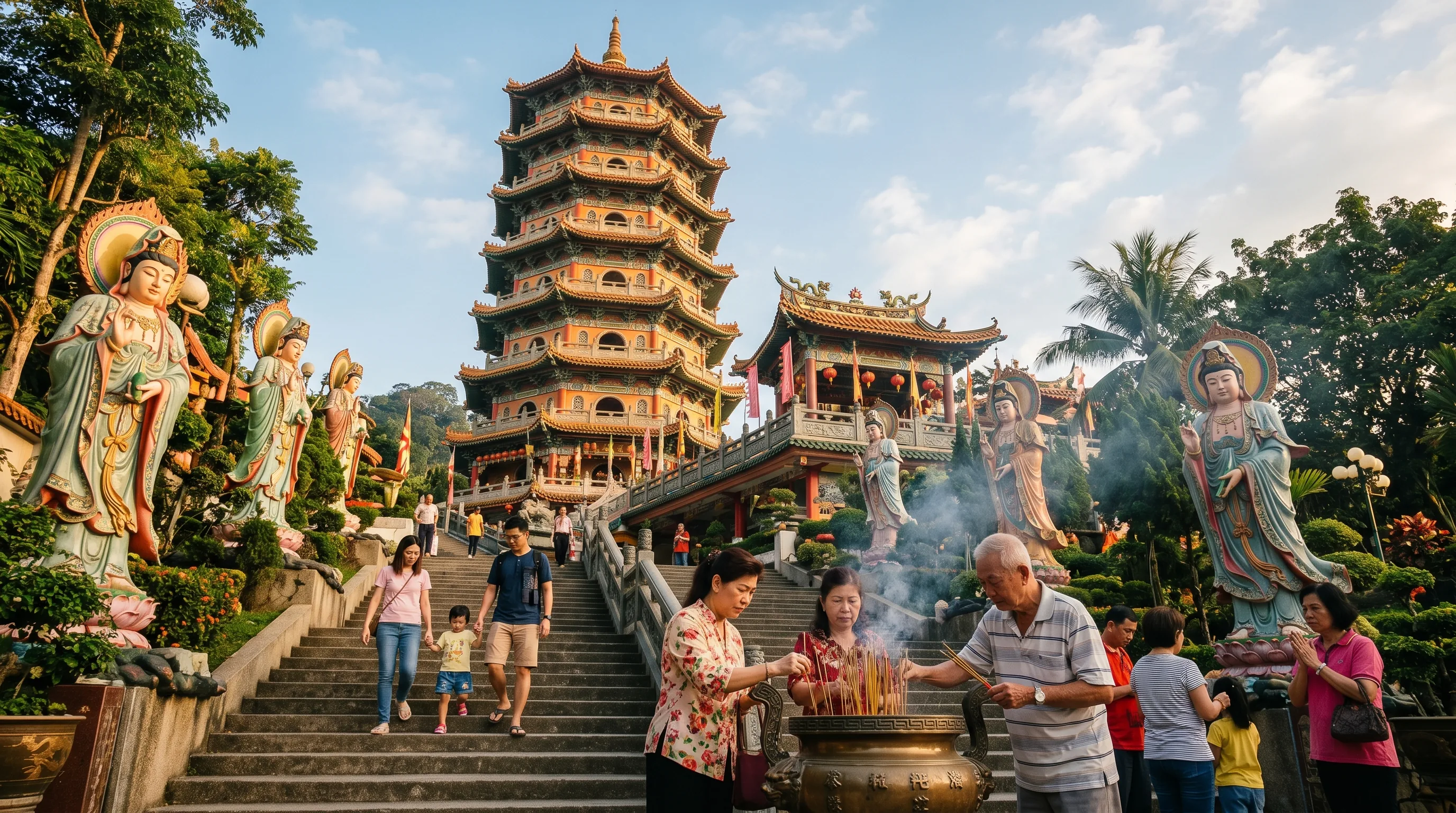
Puh Toh Tze Temple: Sabah's Largest Buddhist Temple
What is Puh Toh Tze Temple?
Puh Toh Tze is the first and largest Mahayana Buddhist temple in Sabah, built in 1980 off Tuaran Road near Kota Kinabalu. It is famous for an eleven-storey pagoda and a 30,000-pound Guanyin statue, with free daily entry.
Puh Toh Tze Temple at a glance
Puh Toh Tze Buddhist Temple — also known as Puh Toh Buddhist Temple, from the Mandarin Pu Tuo Si — is one of the most striking religious landmarks near Kota Kinabalu. Tucked off Tuaran Road in the Bandau area, it is the first and largest Mahayana Buddhist temple in Sabah and counts among the largest Buddhist temple complexes anywhere in Borneo.
Built in 1980, the temple draws worshippers and curious visitors alike with its tall orange-and-green pagoda, a grand stone staircase guarded by deity statues, and a towering Guanyin figure at its heart. Entry is free, photography is welcome, and the temple is open every day — making it an easy and rewarding stop for anyone exploring the state capital.
Built 1980 · Off Tuaran Road, Bandau area, near Kota Kinabalu · First and largest Mahayana Buddhist temple in Sabah · Eleven-storey pagoda · 30,000-pound Guanyin statue · Free entry, open daily, photography permitted.
History and significance
Puh Toh Tze was built in 1980, a period when Sabah's Chinese community was establishing some of its most enduring places of worship. From the outset it held a special place: it was the first Mahayana Buddhist temple of its scale in the state, and it remains the largest to this day.
Its significance reaches beyond Sabah. As one of the largest Buddhist temple complexes in Borneo, Puh Toh Tze is a focal point for the practice of Mahayana Buddhism on the island and a symbol of the Chinese community's deep religious roots in the region. For visitors, it offers a window into the living traditions that have shaped Sabah's cultural landscape.
The pagoda and deity statues
The temple's most recognisable feature is its eleven-storey pagoda, painted in vivid orange and green that stands out against the sky. The pagoda gives Puh Toh Tze its commanding silhouette and is the image most travellers carry away from a visit.
At the main entrance, a stone staircase rises toward the temple, flanked on either side by ten large deity statues. These figures line the approach like guardians, setting a ceremonial tone as visitors ascend toward the central halls. The combination of the colourful pagoda and the statue-lined staircase makes the complex one of the most photogenic religious sites near Kota Kinabalu.
The Guanyin statue
The centrepiece of Puh Toh Tze is a monumental statue of Guanyin, the Goddess of Mercy, positioned at the central entrance. Weighing 30,000 pounds, the figure is the temple's defining feature and a major draw for worshippers, who come to pay their respects to one of the most beloved figures in Mahayana Buddhism.
Guanyin is revered as the embodiment of compassion, and her presence at the heart of the temple reinforces Puh Toh Tze's role as a place of devotion and reflection. Visitors are welcome to view the statue, but should remain mindful that this is an active site of worship.
Come in the morning for a quiet, peaceful atmosphere with soft light on the pagoda. Time your visit for Chinese New Year to see the temple at its most vibrant, when it hosts its major annual celebrations.
Planning your visit
Puh Toh Tze is easy to add to any Kota Kinabalu itinerary. It lies off Tuaran Road in the Bandau area, a short drive from the city. The temple is open daily and suitable for all visitors, and there is no entrance fee. Photography is permitted throughout the grounds.
| Detail | Information |
|---|---|
| Location | Off Tuaran Road, Bandau area, near Kota Kinabalu |
| Built | 1980 |
| Entry | Free |
| Opening | Open daily |
| Photography | Permitted |
| Best time | Mornings for calm; Chinese New Year for celebrations |
Temple etiquette
Puh Toh Tze is a living place of worship, so a little courtesy goes a long way. Dress modestly, keep your voice low, and move calmly through the halls and grounds. While photography is permitted, ask before photographing people at prayer or any ceremony in progress.
Do not touch altars, statues or offerings unless you are invited to, and avoid stepping into roped-off or clearly devotional areas. Treating the temple with the same respect you would show any sacred space ensures that worshippers and visitors can share it comfortably.