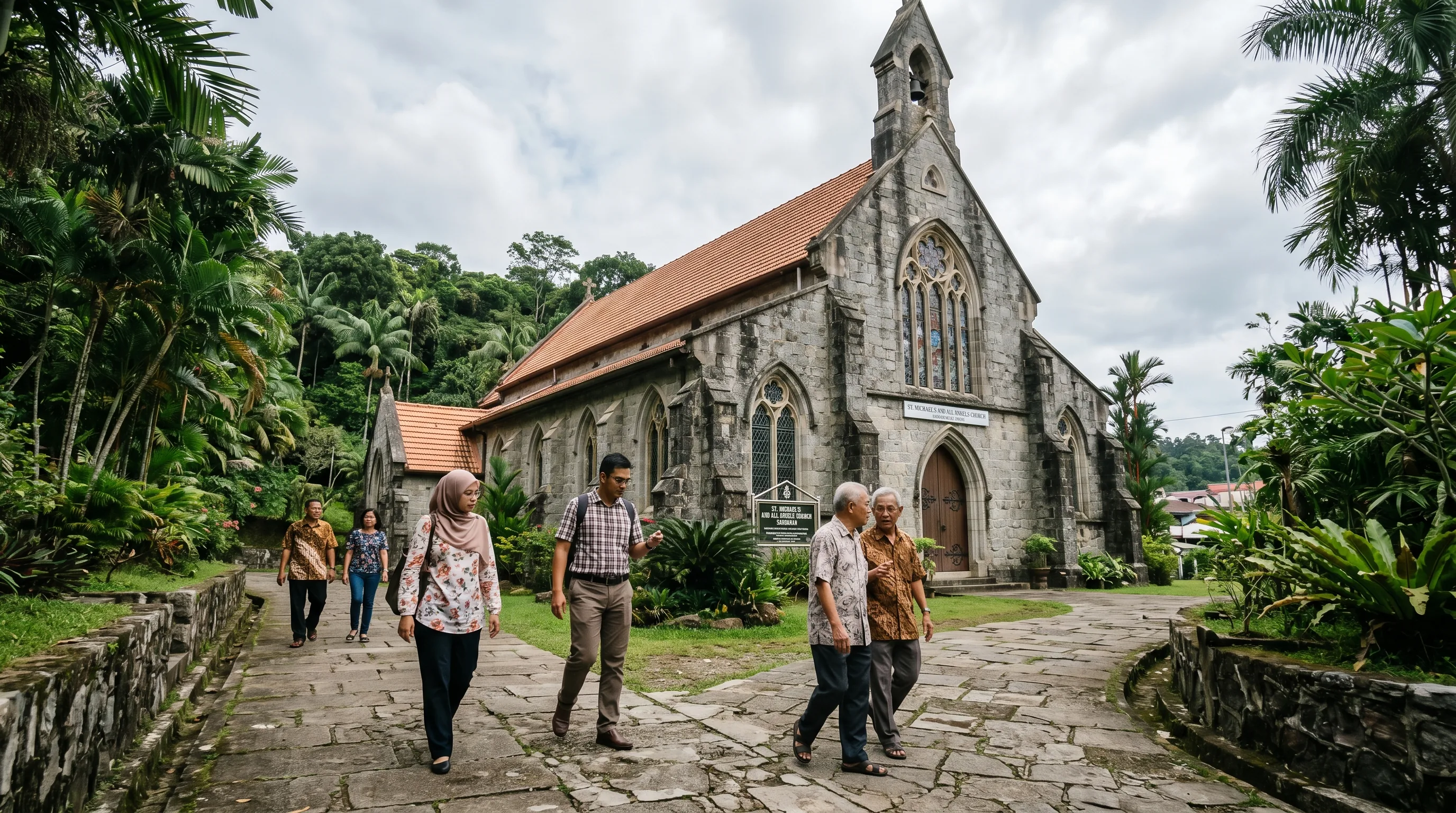
St. Michael's Church Sandakan: Sabah's Oldest Church
What is St. Michael's Church in Sandakan?
St. Michael's and All Angels is an Anglican church in Sandakan and the oldest stone church in Sabah. Its foundation stone was laid in 1893 and it took over 30 years to complete, finishing in 1925.
St. Michael's Church at a glance
St. Michael's and All Angels Church is an Anglican church in Sandakan and one of Sabah's most important heritage buildings. It holds a unique distinction: it is the oldest stone church in Sabah and the first completely stone-built building in the state. For a town that grew quickly in the late nineteenth century, the slow, deliberate raising of a stone church was a statement of permanence.
Today the church is a fixture on the Sandakan Heritage Trail, drawing visitors who come for its history as much as for worship. Its weathered stone walls tell a story that spans more than three decades of construction, a world war, and a century of community life on the Sabah coast.
St. Michael's remains an active Anglican church as well as a heritage site. Dress modestly, keep noise low, and be mindful of services. Photography is generally welcome outside; please ask before photographing the interior or anyone at prayer.
Foundation and a 30-year build
The story of St. Michael's begins with the clergyman William Henry Elton, who arrived in Sandakan on 2 September 1888. Five years later, on 29 September 1893, he laid the foundation stone of the church that would become his lasting legacy in the town.
The design came from a New Zealander, Mr. B.W. Mountfort. What followed, however, was anything but quick. Building a stone church in a young frontier town was a formidable undertaking, and the work stretched on for decades. The church was not completed until 1925 — more than thirty years after that first foundation stone was set in place.
From ironwood to Sabah's first stone building
The long construction reflects a building that evolved as it rose. Work began with belian (ironwood) timber, the durable native hardwood of Borneo, then progressed to brick, and was finally realised in stone. That stone was sourced from Buli Sim Sim, near Sandakan, giving the church its solid, grounded character.
One distinctive detail sets it apart: the white stones used for the windows and doors were brought from Hong Kong, a reminder of the trading links that connected Sandakan to the wider region in its heyday. The end result was the first fully stone-built structure in Sabah — a milestone in the state's architectural history and a benchmark against which later stone buildings would be measured.
War damage and the Australian windows
Like much of Sandakan, St. Michael's did not escape the Second World War unscathed. The church was damaged during the war, a period that left deep marks on the town and its people.
One of the church's most poignant features dates from the years that followed. Its coloured stained-glass windows were donated by Australians to commemorate the 60th anniversary of the end of the Second World War. The gift ties St. Michael's to the shared wartime history of Sandakan and Australia, and the windows remain a moving point of interest for visitors today.
The Anglican Diocese of Sabah
St. Michael's belongs to the Anglican Church in Sabah, whose diocese was founded in 1962 as the Diocese of Jesselton. When Jesselton was renamed Kota Kinabalu in 1967, the diocese became the Diocese of Sabah. Its cathedral is All Saints' Cathedral in Kota Kinabalu, while St. Michael's stands as one of the diocese's most historic churches.
The Anglican story in the wider region runs deeper still. The Church of Our Holy Saviour in Labuan was the first Anglican church on the island, consecrated in 1866, and St. James' Anglican Church in Kudat was established by Hakka Christians. Together these churches map the early spread of Anglicanism across North Borneo. More information about the diocese can be found at anglicansabah.org.
Christianity across Sabah
Anglicanism is only one strand of Sabah's Christian heritage. Among Protestant communities, the largest is Sidang Injil Borneo (SIB), the Borneo Evangelical Church, founded in 1928 in Sarawak. It is the largest Protestant church in Malaysia and the largest indigenous Christian denomination in Sabah and Sarawak, with more than 500,000 members across over 500 congregations. From the 1950s it rapidly reached Kadazan-Dusun, Murut and other indigenous communities, and translated the Bible into local languages.
The Methodist Church in Sabah adds another chapter: its first worship service in Kota Kinabalu was held on 4 April 1983, and it grew into the Sabah Annual Conference on 9 November 2018. Set against this backdrop, St. Michael's represents the older, colonial-era Anglican presence from which much of Sabah's Christian life would later branch out.
Visiting St. Michael's on the Heritage Trail
St. Michael's is open to visitors and forms part of the Sandakan Heritage Trail, a walking route that links the town's most significant historic sites. It is a natural stop on any heritage-focused tour of Sandakan, and its stonework rewards a slow, close look.
As with any place of worship, a few courtesies apply. Dress modestly, keep your voice down, and be aware of services that may be in progress. Photography is generally welcome outdoors, where the stone facade and pointed windows are at their most striking; please ask before photographing inside. Pause, too, before the Australian stained-glass windows — a quiet reminder of the wartime history woven into the building's walls.
St. Michael's pairs naturally with Sandakan's other historic landmarks, including the Goddess of Mercy and Sam Sing Kung temples, for a fuller sense of the town's layered past.