Mengkuang Weaving in Sabah: Pandanus Leaf Crafts
What is mengkuang weaving?
Mengkuang weaving is a traditional Sabah craft that turns dried, split and naturally dyed pandanus leaves into mats, baskets, hats, bags and decorative items. It is practised across several ethnic groups, especially Bajau and Orang Sungai communities, and produces more than 70 documented product types.
What is mengkuang weaving?
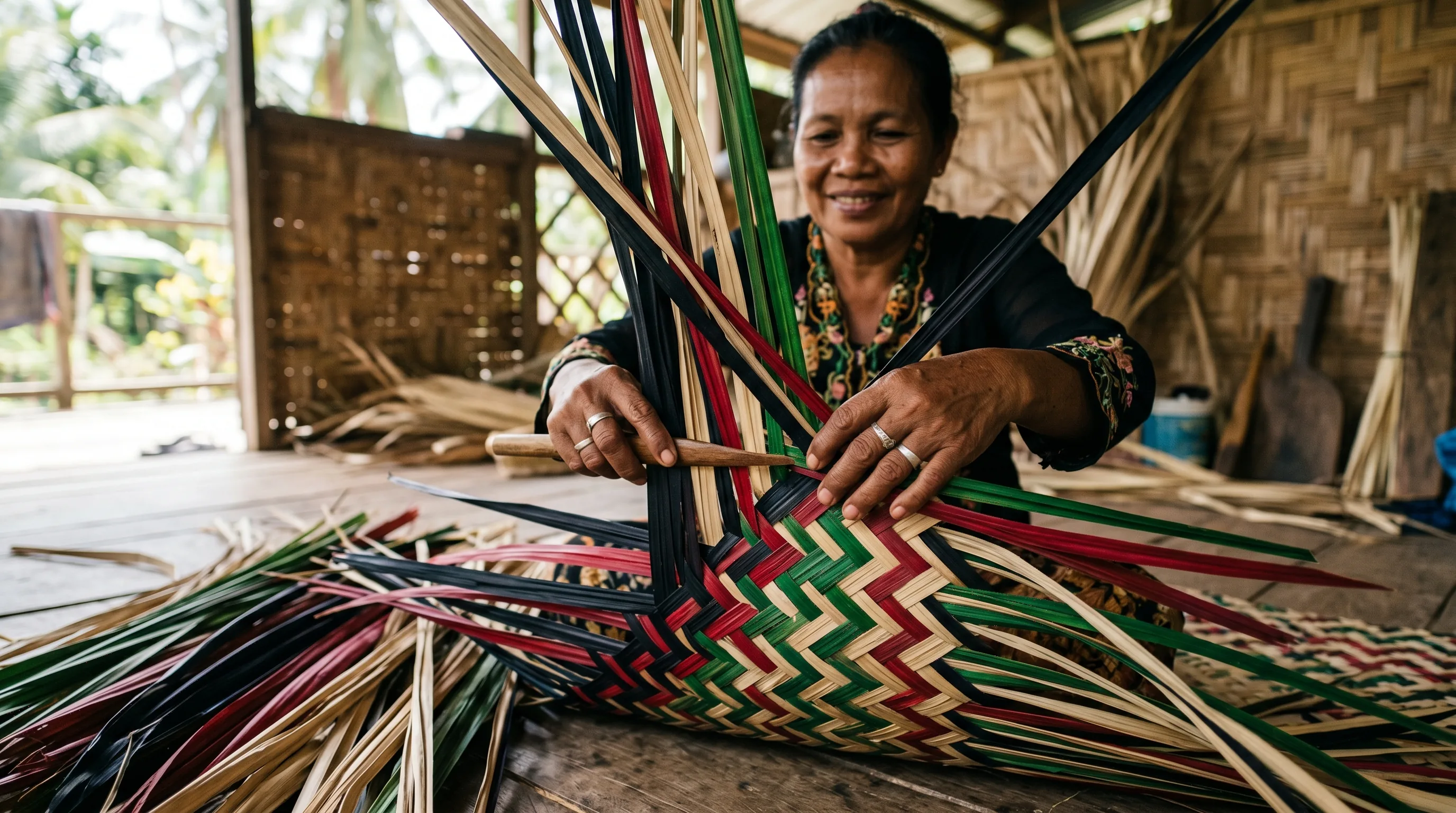
Mengkuang weaving is one of Sabah's most widespread and enduring craft traditions. The word refers both to the pandanus plant whose leaves supply the raw material and to the plaiting technique used to transform those leaves into useful and decorative objects. Long, blade-like pandanus leaves are harvested, dried, split into even strips and frequently dyed in natural colours before being interlaced by hand into mats, baskets and a wide range of other goods.
Unlike crafts tied to a single community, mengkuang weaving is shared across many of Sabah's ethnic groups. This breadth makes it a kind of common cultural language: although techniques and finishing details vary from place to place, the basic act of splitting pandanus and plaiting it into form is recognised throughout the state. The craft remains an active, living tradition rather than a museum piece, with weavers still producing items for everyday use and for sale.
As a cottage industry, mengkuang weaving has long supported rural households, particularly along Sabah's coasts. Pieces move from home workshops to local markets, cultural festivals and tourist-facing venues, giving the craft both a domestic role and a place in the wider visitor economy.
The pandanus material and natural dyes
The foundation of the craft is the pandanus, or mengkuang, plant. Its leaves are gathered and then dried, a step that stabilises the material and prepares it for handling. Once dried, the leaves are split lengthwise into narrow, regular strips. The consistency of these strips matters: even widths produce tidy, repeating patterns, while uneven ones disrupt the weave.
Colour comes from natural dyes derived from plant sources rather than synthetic pigments. The traditional palette centres on black, red and green, which weavers introduce by dyeing batches of strips before plaiting begins. Because the colours are built into individual strips, the patterns that appear in a finished mat or basket are a direct result of how dyed and undyed strips are arranged during weaving.
Pandanus leaves are long, flexible and strong once dried, which is exactly what a durable plaited mat or basket needs. Their natural length also reduces the number of joins a weaver has to make, keeping the surface smooth and even.
This reliance on a locally available plant and plant-based dyes keeps the craft closely tied to its environment. The material is renewable, the processing is low-technology, and the skills can be passed directly from one weaver to the next within a household or village.
Weaving techniques and patterns
Mengkuang weaving is built on plaiting, in which strips pass over and under one another at angles to create a stable, interlocked surface. Two patterns are especially characteristic of the craft in Sabah: the herringbone and the diamond. Both are produced by carefully controlling the sequence in which strips cross, and both can be made more striking by alternating naturally dyed strips with undyed ones.
The herringbone pattern creates a series of repeating, zig-zag lines that give mats and baskets a sense of movement and direction. The diamond pattern, by contrast, builds up lattice-like geometric shapes across the surface. Skilled weavers combine these motifs with their colour choices to produce pieces that are functional yet visibly decorative.
Because the work is done entirely by hand, the rhythm of weaving and the tension applied to each strip shape the final result. Tighter weaving yields firmer, more hard-wearing pieces suitable for daily use, while looser arrangements can be used for lighter or more ornamental items. The same fundamental technique therefore supports everything from a sturdy floor mat to a delicate wall hanging.
Who weaves mengkuang in Sabah
Mengkuang weaving is found across multiple Sabah ethnic groups, which is part of what makes it so widespread. Within this broad picture, two communities stand out for their association with the craft. Along the west coast, Bajau communities are well known for their pandanus weaving, while on the east coast the Orang Sungai are similarly recognised for the tradition.
This coastal spread reflects both the availability of pandanus and the long-standing place of plaited goods in daily life. Mats, baskets and other woven items have practical household uses, and the knowledge required to make them has historically been transmitted within families and villages rather than through formal schooling.
The craft's continuity is also supported at a national level. KRAFTANGAN, the Handicraft Board of Malaysia, promotes mengkuang weaving through training programmes. This institutional backing helps keep skills alive, encourages new weavers and connects rural producers with wider markets, reinforcing the craft's status as an active rather than fading tradition.
Products and where to buy them
One of the most remarkable features of mengkuang weaving is its range. There are more than 70 documented product types made from pandanus, spanning both everyday utility and decorative craft. Mats, known locally as tikar, are among the most familiar, alongside baskets, hats, bags, placemats, decorative boxes and wall hangings. This variety allows the same material and techniques to serve many different needs.
For visitors, mengkuang pieces are an accessible and authentic souvenir. Because the craft functions as a cottage industry, finished goods are sold through local markets, cultural events and craft venues rather than large factories. The Gaya Street Sunday Market in Kota Kinabalu is a particularly reliable place to find a selection of pandanus weaving alongside other Sabah handicrafts.
Look at how even the strips are and how tight the weave feels. Consistent strip widths and a firm, regular surface are good signs of careful workmanship in a mengkuang mat or basket.
Buying directly from markets and cultural events also supports the weavers and helps sustain the tradition. With the added backing of KRAFTANGAN training programmes, mengkuang weaving continues to be a craft that visitors can both admire and take home.