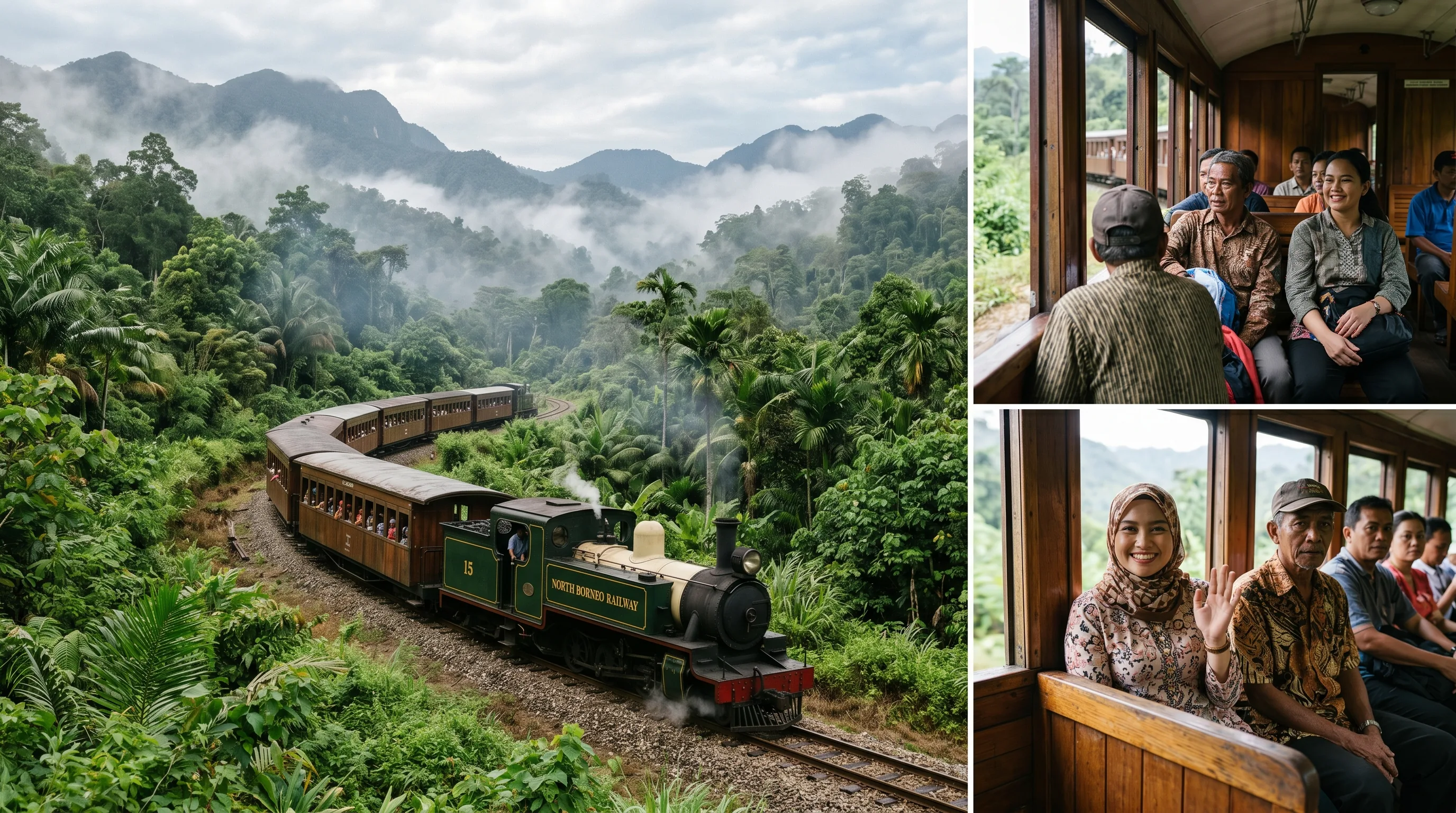
Trans-Borneo Railway: Proposed Cross-Border Rail Link
What is the Trans-Borneo Railway?
The Trans-Borneo Railway is a proposed ~1,600 km cross-border line linking Sabah, Sarawak, Brunei and Kalimantan. Estimated at USD 70 billion, it is a pre-feasibility concept; a study began in June 2025, with results due Q3 2026.
What is the Trans-Borneo Railway?
The Trans-Borneo Railway is a proposed cross-border railway that would link the territories of Sabah, Sarawak, Brunei and Kalimantan (Indonesia) — connecting, for the first time by rail, the different parts of the island of Borneo.
The concept envisions a line of roughly 1,600 km spanning the island. If realised, it would represent a major addition to Borneo's transport network, complementing existing road infrastructure with a continuous rail connection across national borders.
It is important to be clear about the project's status: the Trans-Borneo Railway is currently a pre-feasibility concept and is not yet committed to construction. The figures and routes described here reflect the proposal as it stands while studies are carried out.
The proposed route
The proposed alignment would run through several towns and cities across Borneo. The connections under discussion are:
- Kota Kinabalu (KK) — the Sabah starting point
- Beaufort
- Sipitang
- Limbang (Sarawak)
- Miri
- Kuching
In addition to this main corridor, the proposal includes a branch into Kalimantan, extending the network into the Indonesian part of the island. This routing reflects the project's cross-border ambition, threading through Malaysian states, Brunei's neighbourhood and Indonesian territory.
Cost and scale
The Trans-Borneo Railway is a very large undertaking. The estimated cost is around USD 70 billion (roughly RM330+ billion), and the estimated length is approximately 1,600 km across Borneo.
Figures of this magnitude place the project among the largest infrastructure concepts in the region. The scale is one reason the proposal is being approached carefully, with detailed study before any commitment to construction.
| Detail | Estimate / status |
|---|---|
| Estimated length | ~1,600 km across Borneo |
| Estimated cost | USD 70 billion (~RM330+ billion) |
| Feasibility study commenced | June 2025 |
| Study results expected | Q3 2026 |
| Current status | Pre-feasibility concept; not yet committed to construction |
The feasibility study timeline
A formal feasibility study commenced in June 2025, with results expected in Q3 2026. A feasibility study examines whether a project is technically workable, financially viable and practical to deliver, before any decision is made to proceed.
Until that study is complete and its findings reviewed, the railway remains a concept rather than a confirmed project. The study's conclusions will be an important indicator of whether — and in what form — the Trans-Borneo Railway might move forward.
The Trans-Borneo Railway has not been committed to construction. Routes, costs and timelines reflect a pre-feasibility proposal and may change once the feasibility study (results expected Q3 2026) is complete.
Engineering challenges
Building a railway across Borneo would involve several significant technical challenges:
- Mountainous terrain — the route would need to cross the Crocker Range and the rugged interior of Borneo, demanding substantial engineering such as tunnels, bridges and earthworks.
- Cross-border coordination — the line passes through territory involving Malaysia, Brunei and Indonesia, requiring alignment on standards, regulation and operations across jurisdictions.
- Financing — funding a project at the USD 70 billion scale is a major undertaking in its own right.
- Building through intact rainforest — large stretches of the route would pass through dense rainforest, which presents a technical challenge for construction, access and route design in remote, heavily forested terrain.
Each of these factors is part of why careful study precedes any decision to build, and why the project remains at the concept stage for now.
Sabah's existing railway today
For context, it is worth noting that Sabah already operates the only railway on Borneo — the North Borneo Railway / Sabah State Railway. This historic line runs 134 km from Kota Kinabalu to Tenom and was built between 1896 and 1905.
This existing railway gives Sabah a long-standing connection to rail transport on the island and a point of reference when considering far larger proposals like the Trans-Borneo Railway. While the historic KK-to-Tenom line is modest in length, it underlines that rail is not new to Borneo — even as any pan-Borneo network remains, for now, a concept under study.