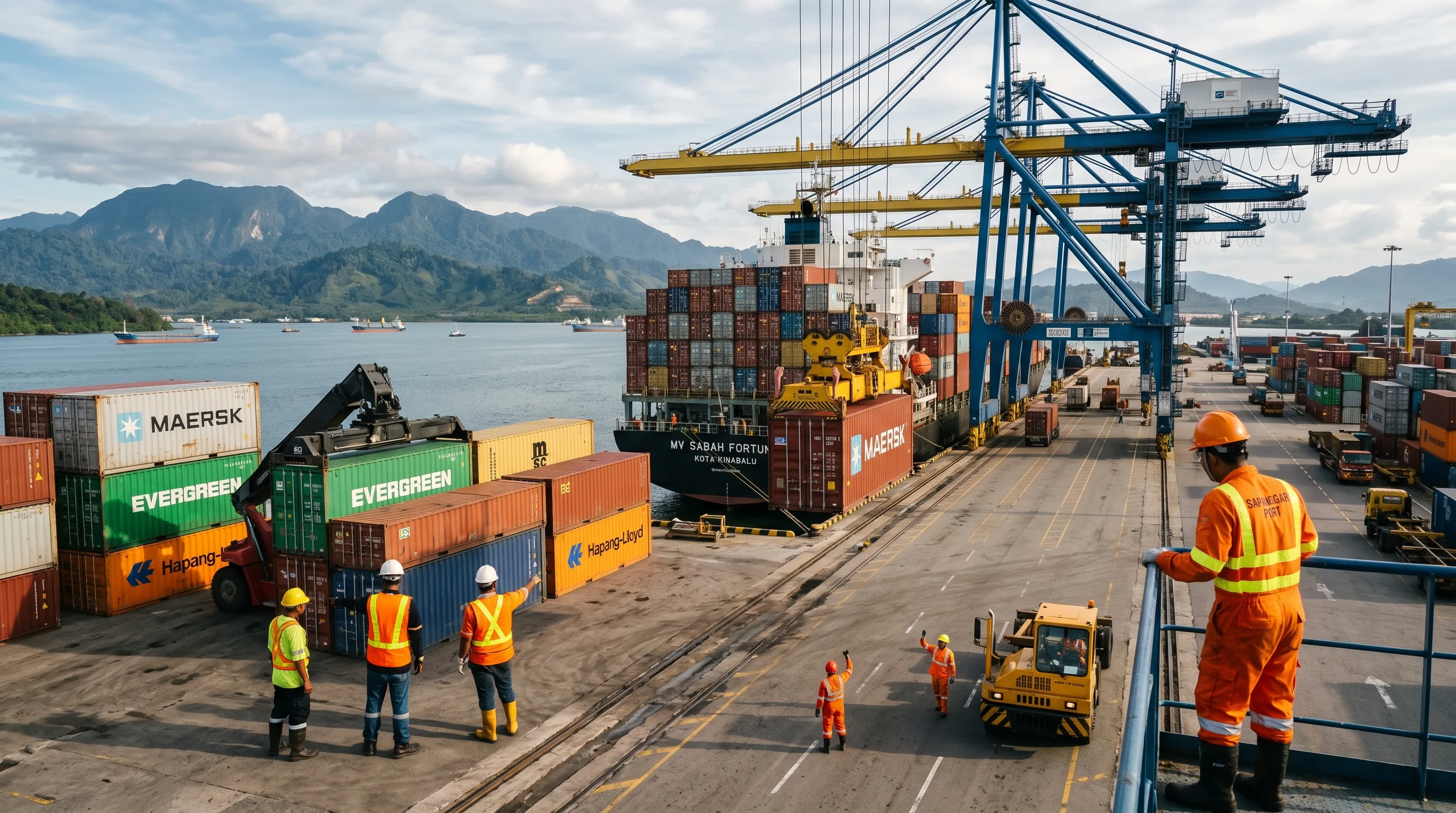
Sepanggar Bay Container Port Expansion
What is the Sepanggar Bay Container Port expansion?
It is a RM1.03 billion project, carried out with DP World, to expand Sabah's only international container port. The work raises annual capacity from 500,000 TEU to a target of 1.25 million TEU, with completion targeted for 2025 to 2026.
What is the Sepanggar port expansion?
The Sepanggar Bay Container Port is the main maritime gateway for the state of Sabah, and it is currently undergoing a major expansion. The project carries a price tag of RM1.03 billion and is designed to dramatically increase how much cargo the port can handle each year.
Throughout this page, container volumes are measured in TEU, short for twenty-foot equivalent unit. One TEU represents a single standard 20-foot shipping container, so when a port quotes its capacity in TEU it is describing how many of those containers it can process in a year. It is the universal yardstick for comparing container ports.
The expansion is being delivered in partnership with DP World, one of the world's leading port operators, with completion targeted for 2025 to 2026. For Sabah, this is one of the most consequential pieces of trade infrastructure in a generation, because it directly determines how easily the state's goods can reach world markets.
Capacity before and after
The headline outcome of the project is a step change in throughput. The table below sets out the before-and-after figures:
| Measure | Capacity |
|---|---|
| Current annual capacity | 500,000 TEU |
| Target annual capacity | 1.25 million TEU |
Lifting capacity from 500,000 to 1.25 million TEU represents roughly a two-and-a-half-fold increase. That additional headroom matters because a port operating near its ceiling becomes a bottleneck, with ships waiting and exporters facing delays. The expansion gives Sabah's trade room to grow for years to come.
The DP World partnership
The expansion is being carried out with DP World, the Dubai-based global port and logistics operator. DP World runs container terminals across dozens of countries, and its involvement brings international operating expertise, technology and logistics know-how to the Sepanggar project.
Bringing in an experienced global terminal operator like DP World can speed up modernisation, improve efficiency and connect Sepanggar more closely to international shipping networks — benefits that are harder to achieve through a standalone local upgrade.
With completion targeted for 2025 to 2026, the partnership is structured to deliver both the physical expansion of the port and an upgrade in how it is operated day to day, from cargo handling to logistics systems.
Why it matters for Sabah exports
Sepanggar is the only international container port in Sabah, which makes it the single most important link between the state's producers and overseas buyers. Almost anything Sabah exports in containers passes through here.
The port is critical for the export of the state's signature commodities and goods, including:
- Palm oil and palm-based products
- Timber and wood products
- Cocoa
- Manufactured goods, including output from nearby industrial parks
Because so much of Sabah's export economy depends on this one facility, expanding it is about more than handling extra boxes. It safeguards the competitiveness of the state's key industries by ensuring they can move products to market reliably and at scale.
The infrastructure upgrades
The RM1.03 billion expansion covers a series of physical and technological improvements to the port. The main upgrades include:
- New container berths to allow more vessels to dock and be worked at once.
- An expanded container yard with additional stacking equipment to store more containers on site.
- Upgraded gantry cranes to speed up loading and unloading of ships.
- Enhanced ICT systems for port logistics, improving the tracking and coordination of cargo.
Together, these elements work as a package. More berths and cranes increase how quickly ships can be served, the larger yard provides somewhere to put the extra containers, and the improved ICT systems tie it all together so that the higher throughput can actually be managed efficiently.
Role in BIMP-EAGA trade
Beyond serving Sabah itself, Sepanggar is positioned as a gateway for trade across the BIMP-EAGA region — the Brunei-Indonesia-Malaysia-Philippines East ASEAN Growth Area. This is a regional cooperation grouping that aims to deepen economic links between these neighbouring territories.
A larger, more efficient Sepanggar port strengthens that role. With more capacity and modern handling systems, the port is better able to serve as a regional transhipment and trade point, helping connect the eastern ASEAN economies and reinforcing Sabah's position within this growth area.