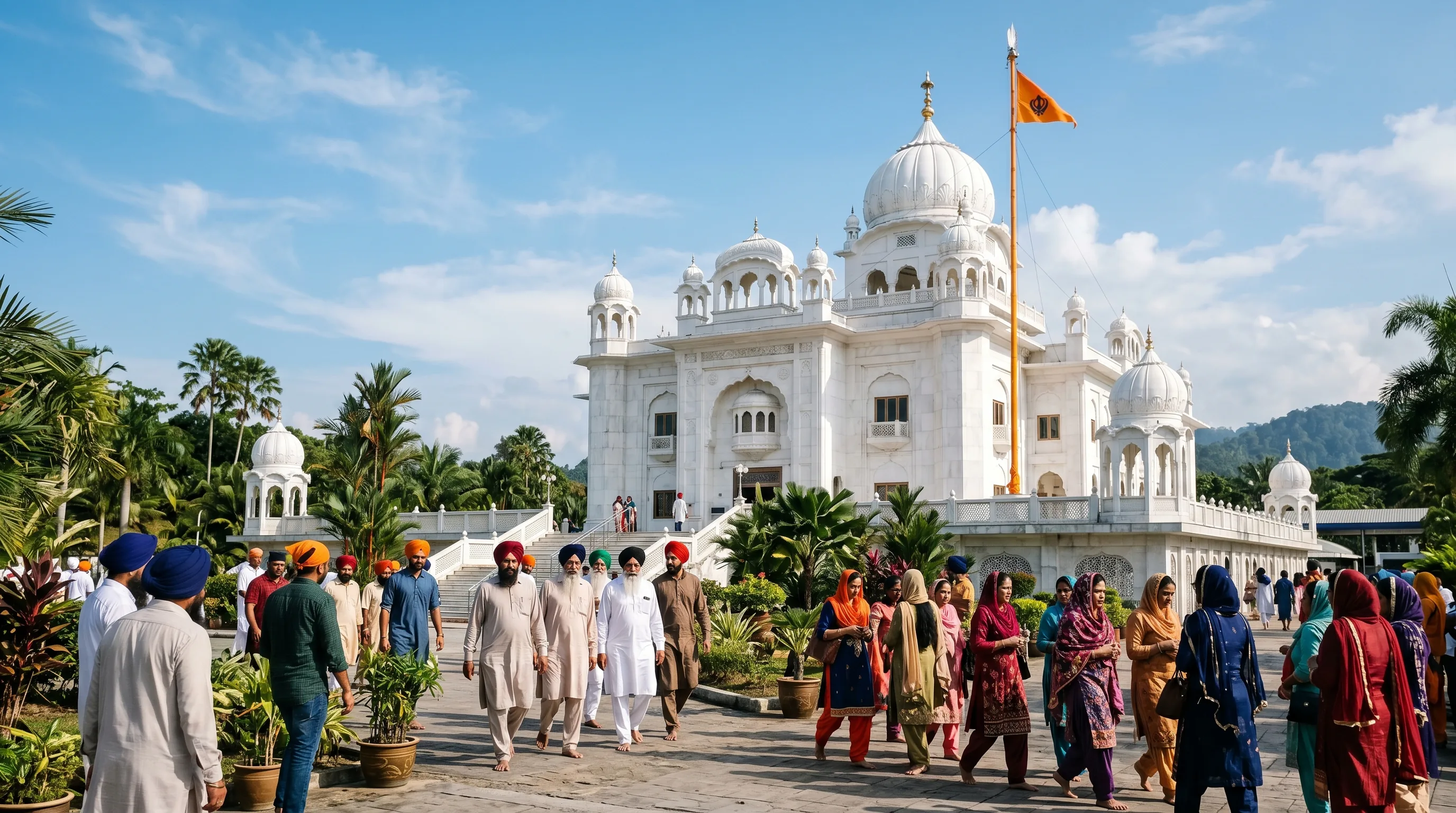
Gurdwara Sahib Kota Kinabalu: Sikh Temple Guide
What is Gurdwara Sahib Kota Kinabalu?
Gurdwara Sahib Kota Kinabalu is the Sikh temple serving Sabah's Sikh community. Its history reaches back to 1924, and the renovated gurdwara was officially opened in 1998, marking a century of Sikh life in the city by 2024.
Gurdwara Sahib Kota Kinabalu at a glance
The Gurdwara Sahib in Kota Kinabalu is the heart of Sikh worship in Sabah. Set on a 0.74-acre site in the state capital, it serves around a hundred Sikh families living in Kota Kinabalu and the surrounding areas. As with gurdwaras everywhere, it is more than a building: it is a place of prayer, learning and community service that has anchored Sikh life in this corner of Borneo for a century.
The story of the gurdwara mirrors the wider story of the Sikh community in North Borneo — a small but enduring presence whose roots run deep. From a relocated prayer site in 1924 to a renovated and extended gurdwara opened in 1998, and on to a centennial celebration in 2024, the building has grown alongside the families it serves.
A gurdwara is a living place of worship that welcomes everyone. Cover your head, remove your shoes before entering the prayer hall, and dress modestly. These small courtesies are appreciated by the community and are part of the shared etiquette of any Sikh temple.
A century of Sikh history in Sabah
The history of the gurdwara reaches back to 1924, when the original site was obtained. At that time, an earlier gurdwara that stood within the compound of the Government Armed Constabulary headquarters was relocated to the new site — an early sign of an organised Sikh community taking root in the region.
From that foundation, Sikh worship in Kota Kinabalu has continued without interruption for a hundred years. In 2024, the community held a centennial celebration marking that full century of history. The milestone honoured the generations of Sikh families who have kept the tradition alive in Sabah, from the earliest settlers to the families who worship at the gurdwara today.
The Singh Sabha Kota Kinabalu
A turning point in the community's organisation came in 1961, with the founding of the Singh Sabha Kota Kinabalu. The society was established by Sardar Sujan Singh Kalsi, who became its first president. A Singh Sabha is, in the Sikh tradition, a society devoted to the welfare of the community and the upkeep of religious life, and the Kota Kinabalu chapter took on exactly that role.
Under the Singh Sabha, the gurdwara became a settled centre for the local Sikh population. The society has continued to oversee prayers, religious education and community gatherings, providing the structure that has allowed the community to flourish across the decades and to mark its later milestones.
Renovation and the 1998 reopening
By the late twentieth century, the gurdwara was ready for renewal. An extensive renovation and extension was carried out across 1997 and 1998, modernising the building and expanding it to better serve the community.
The renovated gurdwara was officially opened on 18 January 1998 by the Chief Minister. The Sabah State Government provided financial support for the project, a reflection of the place the Sikh community holds within Sabah's diverse religious landscape. The reopening gave the community a refreshed home that continues to serve its members today.
The Sikh community of Kota Kinabalu today
Around one hundred Sikh families live in Kota Kinabalu and the surrounding areas, and the gurdwara remains the focal point of their religious and social life. Though small in number, the community is active and closely knit, gathering regularly for worship and shared activities.
Religious education is an important part of that life. About ten Sikh students attend Gurmukhi classes — lessons in the script used to write the Sikh scriptures — on Sundays, helping to pass the tradition on to the next generation. Alongside the classes, the weekly rhythm includes Sunday prayers, sewa (voluntary community service) and community gatherings that keep the families connected.
Visiting the gurdwara with respect
Gurdwaras are known for their openness, and the Gurdwara Sahib in Kota Kinabalu is no exception: all visitors are welcomed, whatever their background or faith. If you would like to visit, a few simple courtesies will help you take part respectfully.
Cover your head with a scarf or cloth, remove your shoes before entering the prayer hall, and dress modestly. Move quietly and be mindful that prayers and services may be in progress. Sunday is the main day of communal worship, when the community comes together for prayers, classes and sewa. Approached in this spirit, a visit offers a genuine window into a faith community that has been part of Kota Kinabalu for a hundred years.
If Sabah's religious heritage interests you, pair the gurdwara with the Hindu temples of Sabah and the well-loved Puh Toh Temple for a fuller picture of the state's many living traditions.